Tuesday, February 14, 2012

Learn more about CSA

Have you ever wondered what's so special about Community Supported Agriculture (CSA) that you should sign up before the season even starts? Or why you should pay before you get your vegetables instead of just buying straight them from the market table?

They're valid questions. Money is tight for many of us these days and we're forced to make tough decisions about how to spend it. I urge you to keep an open mind about CSA as you read on, and consider that it is not only cheaper, but it goes a long way in making sure your food source is secure for years to come.


How does CSA keep my food source secure?


Diversified vegetable farms use CSA as a way to gauge how the market will support their farming efforts. They experience different costs than the larger agribusinesses that are able to supply supermarket shelves – for example, smaller fields and yields but fewer packaging and transportation expenses. However since these small family farms aren’t mass-producers, they rely heavily on the support of their communities. When they sell locally, they’re able to harvest produce within a day or two of market and offer the freshest food possible; vegetables in the supermarket are often picked under-ripe or are engineered to have a long shelf life, and harvested weeks before customers purchase them. Plus, lots of energy goes into trucking them around the country (and the world) and maintaining temperature, humidity, and storage facilities that prevent them from turning quickly.


The more community support that small, local diversified vegetable farms receive, the more viable their livelihood and the longer they’ll be able to continue farming sustainably and offering healthy, fresh food. CSA connects you with this high-quality produce and the people who grow it. So not only do you know who your farmer is, but your farmer knows who you are. When you make a connection with a farmer through CSA, you become more than just a farmers' market customer; you have invested in their business and are demonstrating a commitment to their land and their values. You may be invited to visit their fields or meet their kids, they may ask which vegetables you want them to grow or you may inquire about their top 10 ways to cook a turnip. They will look for you every week.


Why pay for CSA in advance?


If you register before the season begins, your contribution will help the farmer with pre-season expenses like buying seeds and soil amendments, repairing field equipment, and supporting their time as they prepare the fields, start the greenhouse, and begin planting. Committing in advance also helps farmers make crop plans to accurately estimate what and how much to grow based on how many people register for the season.


One of the many benefits to paying in advance is a discounted rate – CSA shares are packaged with wholesale prices in mind, which means your bunch of carrots may be valued at $2 in a CSA share but $2.50 or even $3 on a market table. If you plan on buying a lot of produce this year, the CSA model will save you a significant amount of money (plus it’ll introduce you to new vegetables!)


Why choose Fresh Start Farms' CSA?
Fresh Start Farms is about more than just vegetables – it’s part of a story that’s both local and global, about struggle and resilience, tipping the scale toward the socially disadvantaged in our society, about working hard through resettlement into self-sufficiency; it’s about the right to grow food, transferring skills from fields across the world, creating opportunities for small businesses; it’s about promoting jobs that are consistent with cultural lifestyles and aspirations, and recognizing the similarities between people from all parts of the world.


By choosing Fresh Start Farms, you are supporting immigrants and refugees as they become independent farm business owners. You are welcomed into the lives of people you may have never met, you can try ethnic foods and learn new recipes, and become part of a larger community. Click here for more information about our CSA program and to sign up for 2012.

Tuesday, January 24, 2012

Once upon a time...

Fresh Start Farms has a story. And not just your Maine-farmer-growing-good-food-on-fertile-soil story, or your reclaiming-grandfather's-old-land story. Both of these are important and wonderful but there's something that sets Fresh Start Farms' story apart. This tale traverses the Atlantic Ocean, crosses political and ethnic boundaries, and speaks of resiliency and justice far beyond the average seed saving farmer.


Spend some time learning about Fresh Start Farms' story:


The Resiliency Interviews: The Resiliency Project, a collaboration between Cultivating Community, The Telling Room, and No Umbrella Media, brought youth from our summer programs and refugee and immigrant farmers together for shared farmwork and storytelling around skills of resilience.

There Is My Home is a powerful documentary telling the story of two NASAP farmers as they use agriculture to create roots in Maine. Lanes Island Productions, 2011. Winner of the Audience Choice Award at its premiere at the Lewiston-Auburn Film Festival. This film will rebroadcast on PBS on Thursday Feb. 9th 10 PM and Saturday Feb. 11th, 11AM.

PBS also showcased the NASAP program from 2007 in Letter From Maine: New In Town as part of the Rain in a Dry Land broadcast. This written documentary describes the Somali transition into Lewiston, Maine.

NASAP photos and video interviews are included in this web-based magazine article about U.S. Immigrants reinventing the family farm: A Harvest of Hope by flypmedia (2008).

One of our original funders, Heifer International, posted an article about NASAP growers in New Roots in America.

The Portland Phoenix wrote a short story called "Enjoying the Fruits of a Sudanese Farm in Maine" about one of NASAP growers and his love for food - on the farm and in the kitchen.

Every face you see tells a unique story. Whether it belongs to your friend, your coworker, your waitor, a stranger... Today, take this opportunity to listen, watch, and engage in the faces behind your food, and open your eyes to lives you've never imagined.

Tuesday, January 10, 2012

A breath of fresh air.

Everywhere around you, people are talking about the new year - new beginnings, new resolutions, new commitments, new possibilities...


Fresh Start Farms was born from that spirit. A departure from what was known for the promise of a better life. As these growers can tell you, it's not easy to leave behind the past and move forward, to learn a new language or new customs. It takes an incredible amount of strength not only to resettle, but to actively take hold of opportunities to grow a new life. Every day there are new challenges but these farmers have risen above adverse circumstances and are dedicated to caring for each seed of potential in their fields & in their businesses.


Winter Workshops: The winter is a perfect time to reflect on all of this. This week, farmers began the first series of workshops, trainings and classes, refining their skills and developing plans to prosper in 2012.


During the growing season, it can be hard to budget where time should be spent. At many points in the year, farmers are simultaneously responsible for harvesting crops, planting the next batch of seeds or seedlings, weeding everything in between, and finding time for markets (which still involves washing & packing produce, loading & unloading, traveling, and selling). This wheel exercise is a way to visualize how farmers anticipated dividing their time among different tasks.


Early in January, farmers are already figuring out what they want to grow, how much of each crop they want to plant, and how their field will be organized. There are a lot of factors that go into this - customer preferences (produce diversity for CSA shares and farmers' markets, produce quantity for restaurants and stores ), soil health, sunlight exposure and drainage patterns, proximity to beneficial plants and insects (learn more about companion planting), and quite simply, what the farmers want to feed their families. The exercise in these picture gives farmers the chance to play around with how much of what will grow where!


And the workshops don't end there. Add english classes, financial literacy and business planning, production and marketing trainings, etc... With so much to do, it becomes even more important that these farmers have the resources to afford pre-season expenses like seeds, tools, gas, and even building greenhouse space.


Consider supporting their efforts by purchasing a CSA share. Together we can align our new years resolutions: You want to treat yourself, your community, and your planet with more care and respect, and Fresh Start Farms growers want to continue building a stable home in Maine, to earn enough to feed their families and give their children a good life, and to grow more vibrant fields of green :)

Thursday, December 15, 2011

Low Income CSA shares!

Community Supported Agriculture (CSA) brings together a community of farmers and customers who pledge to support these farmers' operations, sharing the risks & rewards of food production.

Generally the CSA model relies on customers to pay in full before the harvest, which provides growers with the financial security to cover seasonal startup costs. So what happens when a community member wants to support a farmer but lives with a limited income, receiving SNAP (food stamps) benefits?

We have an answer.

Fresh Start Farms is working with Cultivating Community to sign up SNAP recipients for CSA shares for the 2012 season.

Why sign up? There are two major perks:


  1. pay once a month as you receive food, instead of paying upfront

  2. pay half the price: thanks to a doubling program through Wholesome Wave, we are able to match SNAP dollars on CSA purchases--meaning SNAP customers pay for two weeks of every month and Cultivating Community pays for the other two.

Only one catch... we only have a limited number of these low income CSA shares available, so register as soon as possible to reserve your spot!!


Look through the winter gray toward the light at the end of the tunnel, and you will find juicy ripe tomatoes in your future :)
Friday, December 9, 2011

Winter Market & SNAP

Hopefully you're all gearing up for the Portland Winter Farmers' Market opening this Saturday 9am-1pm at the Maine Irish Heritage Center!

Did you know that we will be accepting VISA/MC, as well as SNAP food stamps?? In fact, every time you swipe your food stamps card, you will get DOUBLE the number of tokens... absolutely free! That's right, we'll charge $5 to your card and give you $10 in tokens!

Wondering what you can buy at the indoor market? There are tons of options!

  • Root & greenhouse vegetables

  • Storage crops

  • Dairy products

  • Eggs

  • Honey

  • Breads, grains, flour

  • Tempeh

  • Jams & preserved foods

  • Meats

  • and much more!


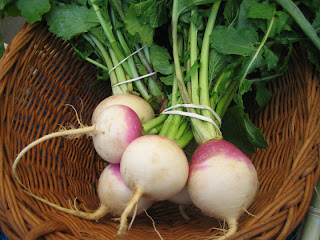
Speaking of root vegetables, we stumbled upon a fun video from the Austin Farmers' Market all about TURNIPS. Get some ideas for this often under-appreciated crop!

Monday, December 5, 2011

Getting more out of your fruit & veggies!

Our friends over at the Lewiston Farmers Market compiled an excellent list of storage tips to help you get more out of your fruit & veggies!

"We tend to think of our refrigerators as a magic box that preserves food. However, it can dry vegetables out, causing them to shrivel. Some produce items in fact, store longer when not put into the refrigerator. "


Check it out and give your veggies the care they need.

Tuesday, November 29, 2011

Video--Portland Farmers' Market

As we get ready to enter winter, let's remember our summer days at the Portland Farmers' Market. This season, a fan created a video that highlighted the outdoor markets, Maine farmers, the SNAP program, and why it's important to eat local food. Check it out!

Farmers' Perspective on Local Food

Remember that Portland's Indoor Farmers' Market begins December 10th at the Irish Heritage Center, located at 52 Gray Street (one block from Mercy Hospital on State St)!